Your AI Voice Agent Sounds Great. Did It Actually Book the Appointment?
Voice AI has stopped being judged on how natural it sounds. In 2026, the only question that matters is whether the task actually got done. Here's why that shift changes what businesses should look for.
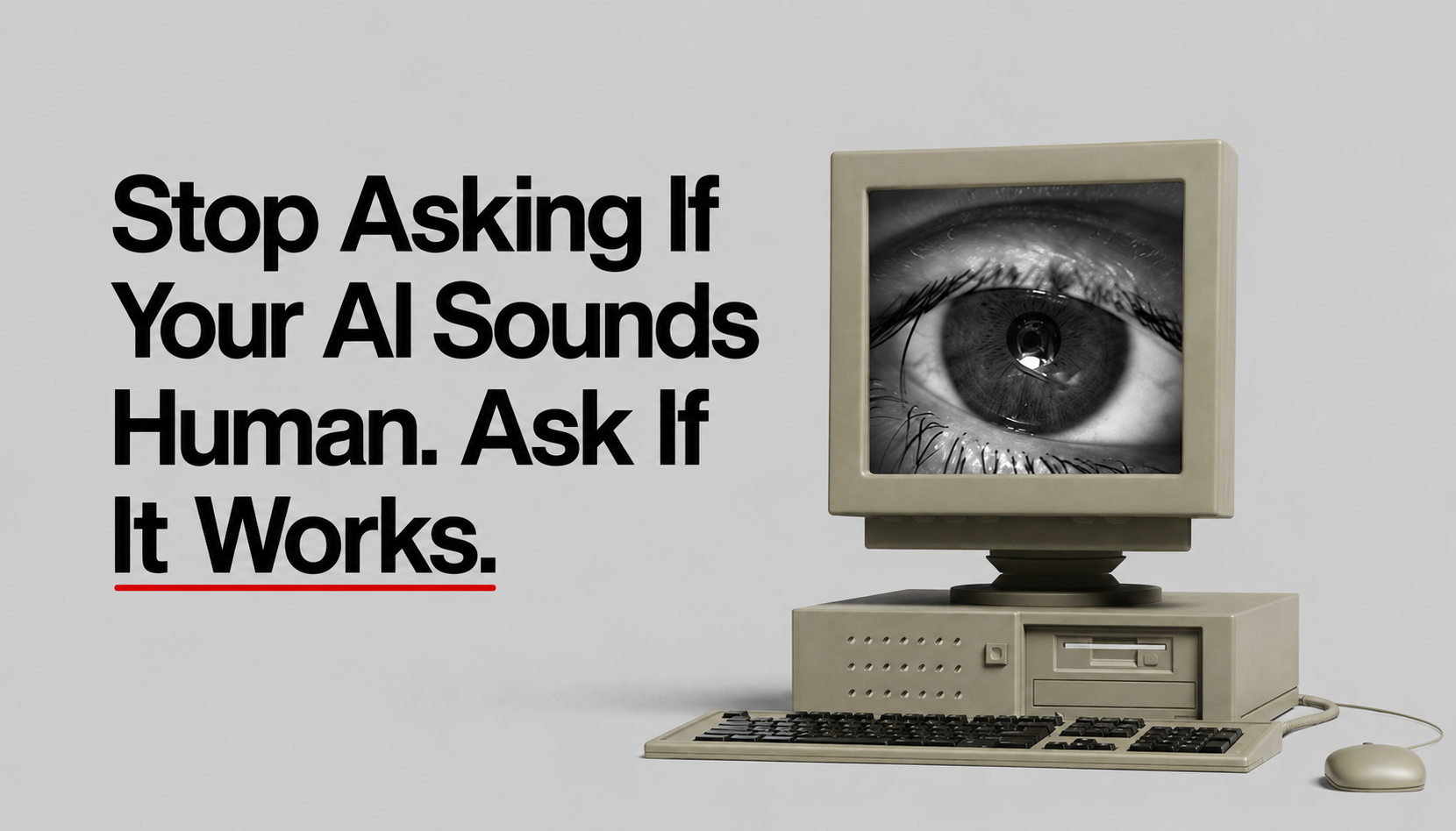
The voice AI industry has shifted its core benchmark: it's no longer "does this sound like a real person," it's "did the task actually finish." A voice agent that sounds convincing but can't complete a booking, issue a refund, or handle an unexpected question mid-call isn't actually useful it just sounds useful. Businesses evaluating voice AI in 2026 should judge it by task completion rate, not by demo-level conversational polish, because the hardest part of any call was never the greeting it's everything that happens after.
Why Did "Sounding Natural" Stop Being the Benchmark?
For the first few years of conversational AI, the industry's biggest challenge was making voice agents sound human natural pacing, realistic tone, no robotic cadence. That problem is now largely solved. Most modern voice agents sound convincing within the first ten seconds of a call.
But sounding convincing and being useful turned out to be two different problems. A voice agent can have flawless pronunciation and still fail the customer if it can't actually reschedule the appointment, apply the right discount, or figure out what the caller actually needs when they go off-script. Industry commentary in 2026 has increasingly converged on this exact point: the interesting metric has shifted from whether the agent sounds natural to whether the task actually finished did the appointment get booked, did the refund get issued. That's a much harder bar, and it's the right one.
What's the Difference Between a Voice Agent That Talks and One That Works?
Talks well: Handles the opening smoothly, answers the first question fluently, sounds warm and natural and then breaks down the moment the conversation goes anywhere unscripted.
Works well: Handles the messy middle of the call the customer who changes their mind halfway through, the question the script didn't anticipate, the moment where a human caller would normally say "let me check" and still lands on a completed outcome.
That messy middle is where most voice AI demos quietly stop showing you anything. It's easy to demo a clean opening line. It's much harder to demo what happens when a customer interrupts, asks something unexpected, or wants to change what they just said.
Why Does the Middle of the Call Matter More Than the Start?
Because the start of a call is the same for almost every voice agent a greeting, a question, maybe a menu of options. Nearly every vendor can nail that part.
The middle of the call is where the actual value of the interaction gets decided:
- Can it handle a customer changing the appointment time twice in the same call?
- Can it correctly interpret an answer that doesn't match any of its expected options?
- Can it still complete the booking if the customer asks three unrelated questions first?
- Does it hand off cleanly to a human when it genuinely can't resolve something or does it just loop the customer back to the start?
A voice agent that can't navigate this part reliably isn't a shorter version of a good voice agent it's a different product with the same voice quality.
How Should a Business Actually Evaluate a Voice AI Vendor?
Instead of asking "how natural does it sound," ask questions that test for actual task completion:
- What's the task completion rate, not just the call-handling rate? A call being "handled" (answered, conversation happened) is a much lower bar than a call resulting in the booking, refund, or resolution actually happening.
- What happens when the conversation goes off-script? Ask for a live demo where you deliberately interrupt, contradict an earlier answer, or ask something unrelated not a pre-recorded clean-path demo.
- How does it hand off to a human, and when? A good voice agent knows the edge of its own competence and escalates cleanly one that never escalates is either overconfident or badly designed.
- Does it remember what was already said earlier in the same call? An agent that forgets the customer's own correction three sentences later will re-ask the same question and frustrate the caller, even if each individual sentence sounds fine.
- What does the system record when a call fails to complete and can you see why? If a vendor can't show you why a task didn't finish, you have no way to actually improve the system over time.
Why Does This Matter More for Businesses Than for Consumers?
For a consumer chatting with an AI out of curiosity, a smooth-sounding conversation might genuinely be enough. For a business deploying voice AI to handle real customer calls, an unfinished task isn't a minor inconvenience it's a missed appointment, an unresolved complaint, or a lead that has to call back and try again, often to a competitor instead.
This is the practical reason task completion, not conversational polish, is the metric that actually predicts ROI. A business doesn't get paid for a call that sounded nice. It gets paid for the appointment that got booked, the order that got confirmed, the lead that got qualified and scheduled.