Why Enterprise Customer Support AI Fails in India And What Good Looks Like
Enterprise AI is growing fast, but customer support still struggles with one basic goal: resolution. This article explores why AI fails when it lacks context, system access and real problem solving, and how Zencia is building AI support agents that actually resolve customer issues.
A Real Conversation That Should Not Happen in 2026
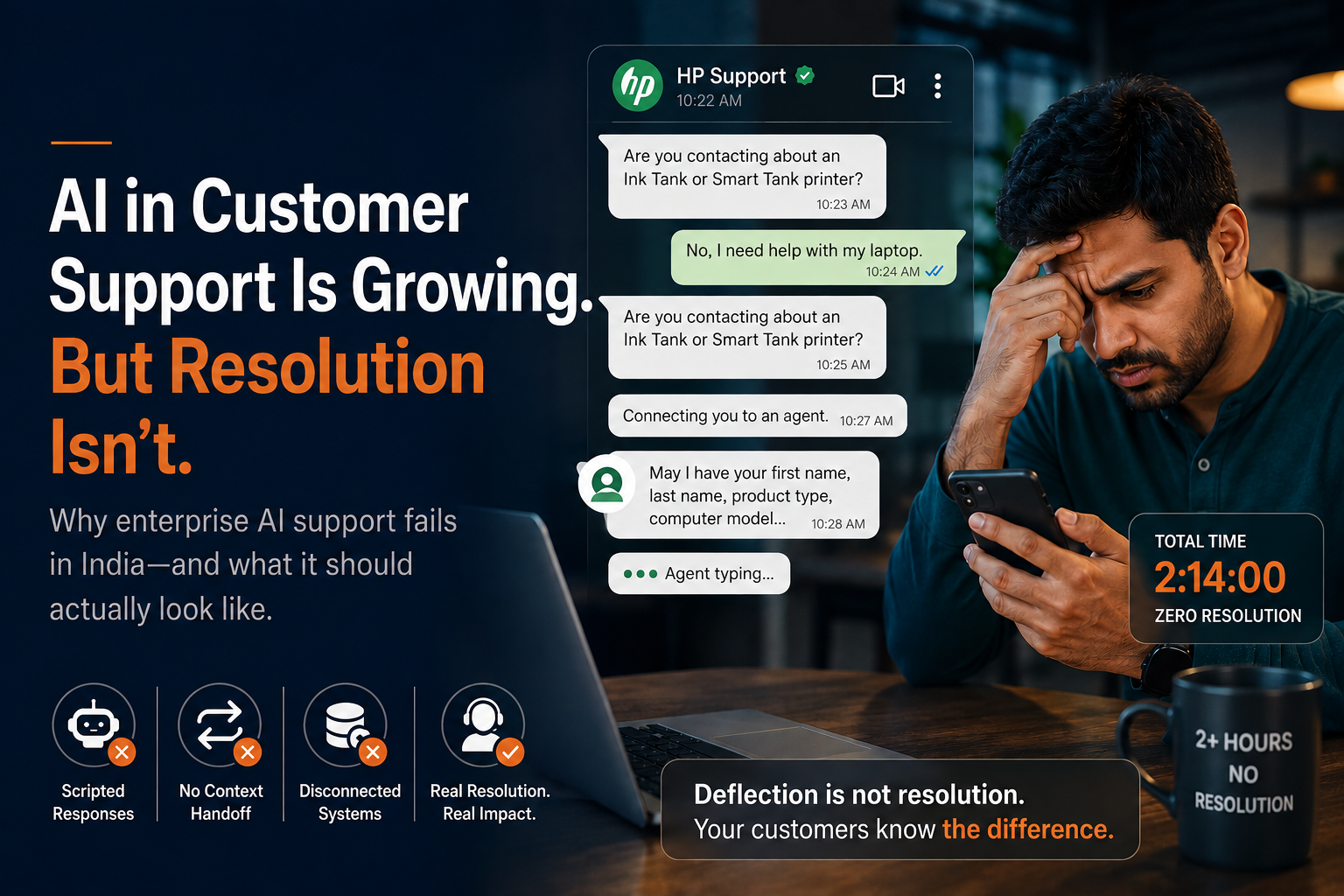
10:22 AM. A customer contacts HP Support on WhatsApp.
His laptop won't start. The screen is blank. The Caps Lock light blinks five times, followed by three quick flashes. This is a known diagnostic pattern. Any trained technician should recognise it immediately.
The AI responds:
"Are you contacting about an Ink Tank or Smart Tank printer?"
The customer says no.
It asks again.
A human agent eventually joins the conversation. The agent asks for the customer's first name, last name, whether the device is for personal or business use, the product type, and the computer model.
Five minutes of questions.
Not a single word about the actual problem.
The customer explains the issue again. The agent disappears. Comes back. Asks for the serial number, email ID, and pin code. Then asks for a video.
Disappears again.
"Are we connected?"
After two hours and fourteen minutes, the customer asks one simple question:
"Is there a service charge just to open the laptop for diagnosis?"
The agent cannot answer this.
"Visit the service centre. They will let you know."
The chat is placed on hold for another two hours.
Zero resolution.
This is not just an isolated support failure. It is a symptom of a much larger problem in India's enterprise AI customer support landscape in 2026.
The Numbers Behind the Problem
The global AI customer service market is projected to reach $15.12 billion in 2026, growing at 25.8% annually. 88% of contact centres are already using some form of AI.
But adoption is not the same as resolution.
Gartner finds that AI can deflect 45% or more of queries, while only 14% of issues are fully resolved through self service.
That gap between deflection and resolution is where Indian customers live every day.
India's business leaders are backing AI with strong boardroom conviction, but customers are not always feeling the impact. Only 38% of Indian organisations have integrated data into a single source of truth. Just 34% are breaking down barriers for seamless AI integration across departments.
And one of the most concerning numbers is that 48% of Indian customers cite a lack of empathy in customer experience, while only 19% of leaders are addressing it with AI.
Companies are deploying AI to cut costs.
Not necessarily to solve problems.
That distinction explains a lot.
Why Enterprise AI Support Fails in India
The HP conversation is not an isolated incident. It represents five systemic failures that can play out across enterprise customer support.
Failure 1: AI deployed as a cost cutting measure, not a problem solving tool
One of the most common reasons enterprises deploy AI in customer support is to reduce agent headcount and lower the cost per contact.
74% of companies show no tangible value from AI investments despite $252.3 billion in collective spending.
When the goal is cost reduction rather than resolution quality, companies often deploy AI that deflects queries instead of AI that resolves them.
The HP chatbot asking printer questions to a laptop customer is a clear example of what happens when a system is designed primarily to route people through a support process rather than understand their actual problem.
Deflection is not resolution.
Indian customers know the difference.
Failure 2: No context across the conversation
The customer in our example stated his problem at 10:22 AM.
He stated it again after connecting to a human agent.
He stated it again after the agent returned from a period of silence.
He stated it again after being put on hold.
Four times.
Same problem. Same customer. Different stages of the support process.
This is what happens when AI and human support operate in separate silos with no shared context layer.
Every handoff becomes a fresh start.
Every fresh start creates another point of frustration.
Enterprise AI fails when AI and human agents operate in isolation. The fix is not simply more AI. It is integrated context that travels with the customer across every touchpoint.
Failure 3: Scripted responses masquerading as intelligence
"I understand that this situation is difficult, but rest assured we will find a solution for you."
"Thank you for staying connected while the conversation gets to me."
"Are we connected?"
These are not intelligent responses.
They are often scripts triggered by keywords. They have little connection to the actual state of the conversation.
AI can deflect a significant percentage of simple queries at the top of the funnel. But complaints, billing disputes, hardware failures and other complex situations are much harder to handle because they require context, reasoning and an understanding of the customer's situation.
A customer with a broken laptop that needs urgent diagnosis is not a simple FAQ customer.
They have a complex, time sensitive problem.
Scripted AI can make that experience worse rather than better.
Failure 4: The handoff problem
In the HP conversation, the AI chatbot collected almost no useful information before connecting the customer to a human agent.
The human agent then had to collect everything from scratch.
This is the handoff problem.
It is one of the most common causes of frustration in enterprise AI support.
A well designed AI support system should capture useful information during the initial interaction. This can include device type, error description, serial number, warranty status and other relevant details.
That information should be passed directly to the human agent before the conversation begins.
The human agent should already understand the problem before saying hello.
Failure 5: AI cannot answer basic operational questions
"Is there a service charge just to open the laptop?"
This is not a complex question.
It is a standard operational query that a properly connected support system should be able to answer instantly from a pricing database.
The fact that neither the AI chatbot nor the human agent could answer this after hours of conversation reveals something important.
The AI was not connected to the systems that contained the answer.
Poor integration into real workflows is one of the most consistently documented causes of enterprise AI failure.
AI that cannot access live pricing, inventory, warranty or case data is not really acting as an AI agent.
It is an expensive FAQ bot.
The India Specific Problem
India's enterprise AI challenge has dimensions that global statistics do not fully capture.
Language and context
India has 22 official languages and hundreds of regional dialects.
Most enterprise AI support systems are built primarily for English or a limited number of major languages.
When customers communicate in Hinglish, regional accents or non standard phrasing, these systems can struggle.
The HP system in our example did offer multiple Indian languages.
But language selection alone does not solve the underlying problem when the AI lacks the intelligence and system access needed to understand and resolve the issue.
Connectivity and response time expectations
Indian customers using WhatsApp support are often on mobile connections that can drop, in environments with background noise, or in situations where they simply cannot wait for extended hold periods.
A support system that puts customers on hold for two hours does not understand the needs of its users.
Trust and cultural context
Indian customers, particularly in Tier 2 and Tier 3 cities, may have lower trust in automated systems when previous experiences have been frustrating.
They are more likely to disengage when they feel they are not being heard.
Scripted responses such as "rest assured we will find a solution" can actively damage trust because customers recognise when a response feels like a copy and paste message rather than a genuine attempt to understand their situation.
Building trust with Indian customers requires demonstrating genuine understanding.
Not simply performing understanding.
What Good Customer Support AI Actually Looks Like
The HP conversation could have been handled in under ten minutes.
Here is what a properly designed AI support system could have done.
Step 1: Immediate problem recognition
"Blank screen and Caps Lock blinking five times followed by three quick flashes" is a diagnostic pattern that can indicate a hardware related issue.
A well designed AI should be able to recognise this immediately.
It could respond:
"Your laptop's Caps Lock blink pattern indicates a potential hardware issue. I am checking your warranty details now."
No printer questions.
No unnecessary information collection.
Just an immediate and relevant response.
Step 2: Automatic context gathering
While the customer describes the problem, the AI can query the relevant customer and warranty systems using the information available from the conversation.
By the time the customer finishes the first message, the AI could know important information such as:
Warranty status: expired on 21/02/2026.
Product: HP Laptop.
Model: identified from available device information.
Location: Lucknow, Uttar Pradesh.
Nearest service centres: three within 10 kilometres.
The customer should not have to provide information the business already has.
Step 3: Answering operational questions instantly
The customer asks:
"Is there a service charge just to open the laptop?"
The AI queries the live service pricing database and responds immediately.
"For out of warranty devices, the standard diagnostic fee is X rupees. This covers opening, assessment and a repair estimate. If you proceed with the repair, this fee is adjusted against the total cost."
The question is answered in seconds.
No unnecessary escalation.
No hours of waiting.
Step 4: Intelligent escalation with full context
If the issue requires a human agent, the AI prepares a complete context summary before the handoff.
Customer name.
Device details.
Serial number.
Warranty status.
Problem description.
Actions already taken.
Customer's unanswered questions.
The human agent reads this before responding.
There is no need for the customer to start the conversation again.
Step 5: Follow through
After the conversation, the AI sends a WhatsApp message with the nearest service centre address, diagnostic fee, estimated turnaround time and case reference number.
The customer leaves the conversation knowing exactly what to do next.
Total time: under ten minutes.
The Real Cost of Getting This Wrong
64% of customers want companies to stop using AI in customer support entirely.
That number is not necessarily a vote against AI.
It can also be a vote against AI that has been implemented badly.
Every frustrating support interaction has a cost.
The customer who gives up and buys from a competitor.
The customer who leaves a one star review that other people read and share.
The customer who never contacts the brand again.
Research also shows that many generative AI pilots fail to deliver measurable returns. The recurring causes are familiar: unclear definitions of success, poor integration into real workflows and a focus on technology rather than business outcomes.
Indian enterprises are spending significantly on AI customer support.
But many still measure success primarily through cost per contact, deflection rate and response time.
Those metrics matter.
But they do not tell the whole story.
The most important question is much simpler.
Did the customer get what they needed?
What Zencia Builds Differently
At Zencia, we design AI support agents around one question:
Did the customer get what they needed?
Not just:
Did the AI deflect the query?
Did the cost per contact decrease?
Was the response time under 30 seconds?
The real question is whether the customer got the right answer and the right outcome.
This means building AI that:
Understands natural language across 40 plus languages, including 10 plus Indian languages and regional accents.
Connects to live systems such as pricing databases, warranty records, inventory and CRM so it can answer operational questions instantly.
Carries full context across every touchpoint so customers do not have to repeat themselves.
Escalates to human agents with complete context rather than starting the conversation again.
Follows through after the conversation with relevant information and next steps.
Knows when to involve a human and does so seamlessly.
This is not agentic AI used as a buzzword.
This is AI that takes action.
AI that retrieves information.
AI that solves the problem.
The difference between AI that performs support and AI that delivers support is not simply model size or technology stack.
It is whether the system was built around the customer's actual problem or around the company's cost reduction target.
The Bottom Line
The HP conversation that opened this article took two hours and fourteen minutes.
The customer had to explain the same problem multiple times.
The system could not answer whether opening a laptop would cost money.
The conversation ended with no resolution.
This is what enterprise AI customer support can look like when it is deployed to deflect rather than resolve.
India has 1.4 billion people.
Billions of customer support interactions happen every year.
Most of them can be better.
The technology to do this right already exists.
The question is whether Indian enterprises will choose to deploy AI that actually works for their customers or AI that simply looks good in a board presentation.
Your customers are waiting.
Not for Agentic AI in a keynote.
For someone who can answer whether opening a laptop costs money.
Zencia's AI support agents resolve queries, not just deflect them, in your customers' own language, 24 hours a day.
Ready to see what good customer support AI actually looks like?
Talk to our team at zencia.ai
Sources: ServiceNow Customer Experience Report 2026, The CX Shift. Gartner AI Customer Service Research 2026. MIT NANDA Project 2025. RAND Corporation AI Failure Study 2024. Lorikeet AI Customer Service Statistics 2026. S&P Global Market Intelligence Voice of the Enterprise 2025. BCG AI Value Study 2024.