The End of SaaS Sprawl: Why Businesses Are Replacing 10 Tools With One AI Employee
The average business now runs over 100 SaaS tools and still can't keep up. Here's why companies are replacing entire tool stacks with a single AI Employee instead.
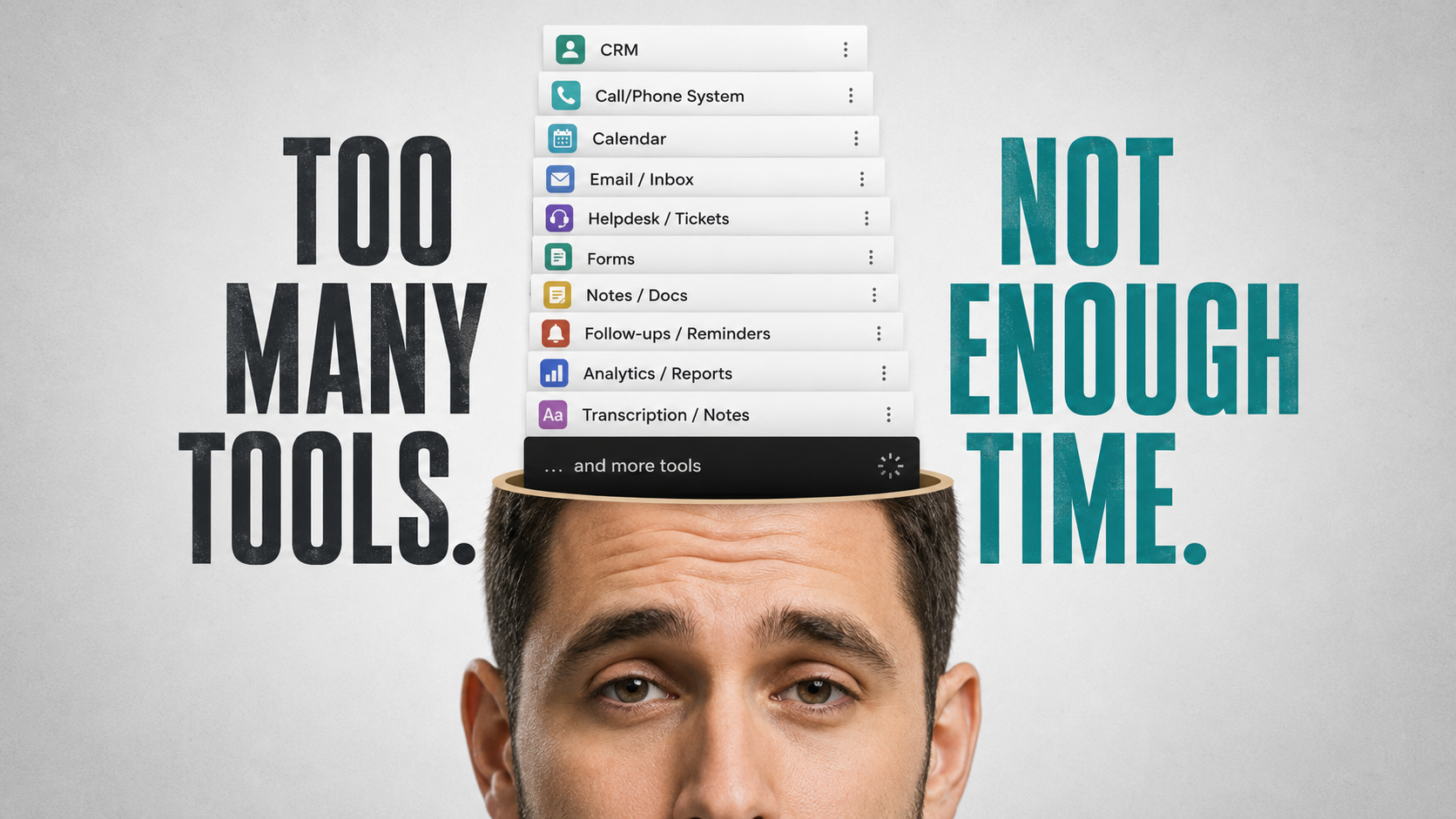
Businesses are consolidating tool stacks into a single AI Employee because SaaS sprawl has stopped solving problems and started creating them: the average company now runs over 100 disconnected apps, more than half of licensed seats go unused, and employees lose hours every week just switching between tools and hunting for information. An AI Employee a single autonomous system that actually completes tasks across support, sales, scheduling, and follow-up removes the coordination overhead that comes from stitching together a dozen point solutions, because it does the work directly instead of giving you another dashboard to manage.
Why Does Every Business Suddenly Have So Much Software?
Software adoption exploded over the last decade because every business problem got its own dedicated app: one tool for chat, one for calls, one for scheduling, one for tickets, one for CRM, one for forms. Individually, each tool solved a real problem. Collectively, they created a new one.
Recent industry data shows the average company now runs over 10+ SaaS applications, with mid-market and enterprise companies frequently running 200–300+. That number has actually declined slightly from its 2022 peak as companies cut obvious redundancies but the underlying problem hasn't gone away, it's just been trimmed at the edges.
What Does Tool Sprawl Actually Cost a Business?
The cost isn't just the subscription fees though those add up fast. It's three compounding problems:
1. Paying for tools nobody uses. Industry research consistently finds that roughly half of all purchased SaaS licenses go unused or barely touched, meaning a meaningful share of most companies' software budget is pure waste sitting on a credit card statement nobody reviews closely.
2. Losing hours to switching, not working. Knowledge workers spend a significant portion of every day simply searching for information scattered across different tools, inboxes, and chat threads time that produces nothing, because it's spent looking for something that already exists somewhere else in the stack.
3. Losing visibility as teams buy their own tools. Most SaaS today is purchased by individual teams, not IT which means most leadership teams genuinely don't have a clear picture of what tools their own company is paying for, let alone whether those tools are actually being used well.
None of this is a "some businesses" problem. It's the default state of running a company on stacked software in 2026.
Isn't More Software Supposed to Mean More Productivity?
That was the original promise of SaaS and for a single tool solving a single problem, it usually holds. The failure isn't in any one app. It's in the coordination between them.
Every new tool added to a stack doesn't just add a capability it adds:
- Another login and password
- Another place customer or task data has to live
- Another notification competing for attention
- Another subscription someone has to remember to renew, review, or cancel
At a certain point, the management overhead of the stack costs more time than the stack saves. That's the tipping point most growing businesses have already quietly crossed.
What's the Difference Between Adding an AI Tool and Replacing the Stack With an AI Employee?
This is the distinction that actually matters, and it's often missed.
An AI tool- a chatbot, a transcription app, an AI writing assistant is just another app added to the same sprawling stack. It still needs to be opened, prompted, and managed. It solves one narrow task and hands the output back to a human to actually act on.
An AI Employee is different in kind, not just degree: it's a single system that takes on an entire role answering every customer call, qualifying every lead, booking every appointment, following up on every quote and does the work itself, end to end, without a human relaying instructions between five different apps to get one task done.
How Many Tools Can One AI Employee Actually Replace?
In practice, a single well-deployed AI Employee like Zencia's Echo can absorb the work currently split across:
- A call answering/reception tool
- A separate appointment scheduling tool
- A basic CRM entry step done manually after each call
- A follow-up/reminder tool
- A call transcription or note-taking tool
That's five separate subscriptions, five separate logins, and five separate points of failure replaced by one system that does the underlying job (answer the customer, understand what they need, take the right action) directly.
Is This Just Another SaaS Trend That Will Add to the Sprawl?
It's a fair concern the SaaS industry has trained buyers to expect that every "solution" becomes one more line item. The difference with an AI Employee model is architectural, not just marketing: instead of being one more specialized point-tool that needs to be stitched into the stack, it's designed to sit across the workflow and reduce how many separate systems a task has to pass through to get done.
The test is simple: does adopting it add another tool to manage, or does it remove several? If it's the former, it's just more sprawl with better branding. If it's the latter, it's an actual fix.