PHP2Shell, Railway and SBI: What a Week of Breaches Means for Businesses Using AI
Three major security incidents in one week show that attacks now move at AI speed. Here's what happened, and the practical steps every business running AI agents should take now.
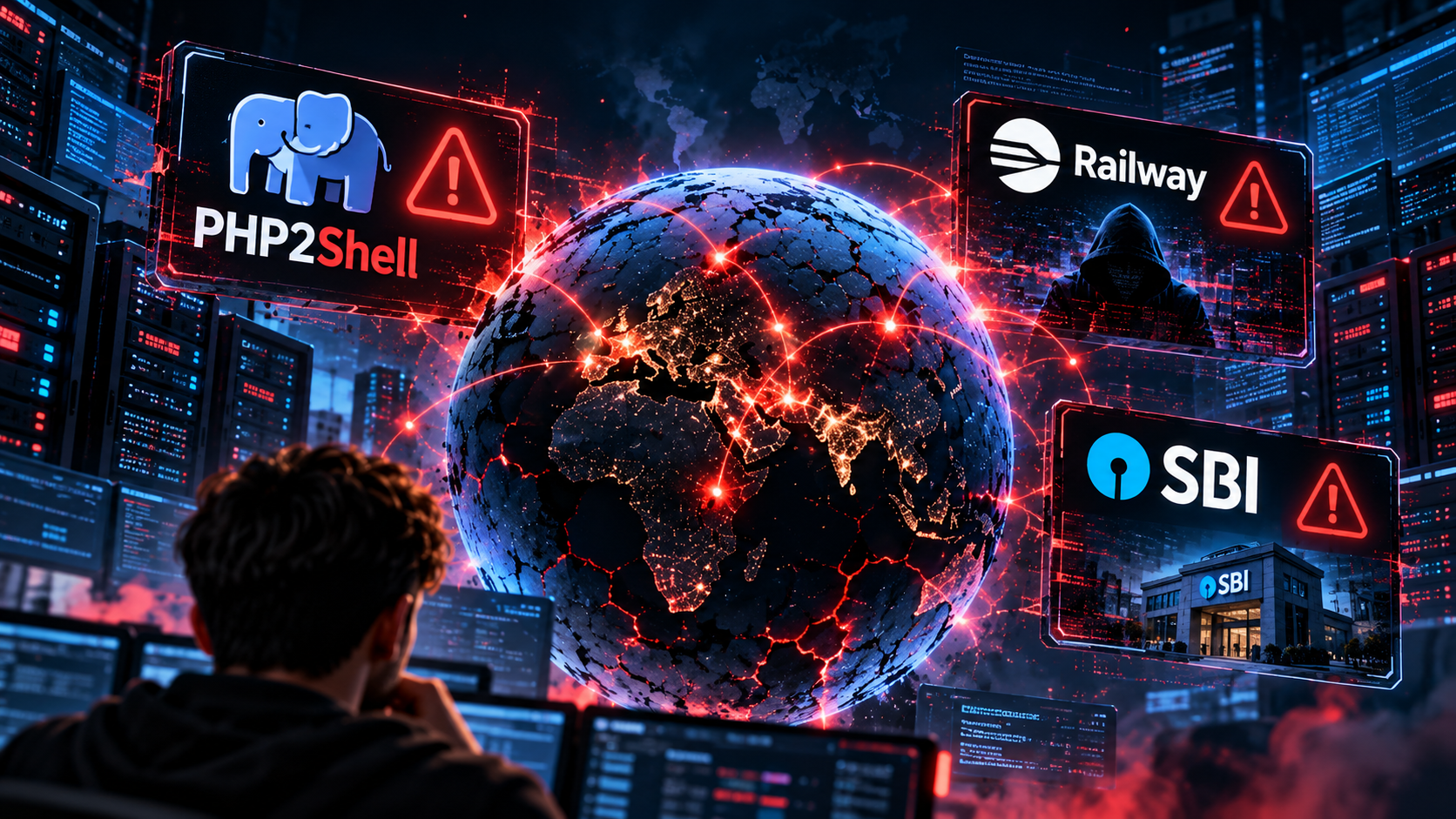
In the space of a few days in October 2026, three very different security incidents made headlines: a critical flaw in PHP, a breach at the developer platform Railway, and a customer data leak at the State Bank of India (SBI).
Different systems. Different attackers. But one shared lesson: the gap between "vulnerable" and "exploited" is now measured in hours, not weeks. And for businesses that run AI agents to talk to their customers, the stakes are higher than ever.
1. PHP2Shell: a critical bug in the language behind much of the web
Two flaws in PHP (CVE-2026-109618 and CVE-2026-109619), nicknamed "PHP2Shell", allow an attacker to take over a server without logging in. PHP rated them 9.2 out of 10 for severity, and they affect PHP versions 5 through 8.
The fix was meant to ship quietly later in the week. Then the details leaked online. PHP rushed out emergency patches on 21 October, Cloudflare reported early attacks the same day, Wikipedia briefly went down, and some government websites in Europe went offline as a precaution.
The most striking detail: AI tools helped discover these bugs. OpenAI says it led a coalition of maintainers and security firms over two months to address them. AI is now finding flaws that survived years of human review, and attackers have access to the same tools.
2. Railway: when your hosting platform holds your keys
Railway is a popular cloud platform with around 4.8 million users and more than 16 million services. It detected suspicious activity on the systems that store customers' environment variables, and found that an unauthorised third party may have accessed encrypted variables and, in some cases, obtained their decrypted contents.
Environment variables are where most teams keep their most sensitive secrets: API keys, database passwords and registry credentials. Railway asked every user to rotate all of them, paused deployments during its investigation, and said the incident was part of a series of attacks targeting AI inference providers.
For an AI business, that last point matters most. The most valuable thing an attacker can steal is often not your data. It's your AI API key, which can be used to run up large bills on your account or be resold.
3. SBI: when the leak is personal
Closer to home, SBI confirmed on 21 October that customer data had surfaced on the dark web. A preliminary review of around 3.75 lakh leaked records found 3,897 containing personal details, including names, mobile numbers, dates of birth, email addresses, home addresses and some loan-related information. A hacker group has claimed a much larger haul, including KYC documents, which SBI has not confirmed.
SBI says its core banking operations are unaffected, and there is no indication that passwords, PINs or transaction details were exposed. The investigation into the source of the data is ongoing.
The real risk here is not a hacked account. It's a convincing phone call. A fraudster who already knows a customer's name, address and loan details can pose as the bank and sound entirely legitimate. Leaked personal data turns ordinary scam calls into targeted ones.
What this means for businesses using AI agents
At Zencia, we build AI employees that answer calls, guide website visitors and talk to customers on behalf of businesses. Weeks like this are a reminder that trust has to be designed into every layer. Here's what we recommend to every team:
- Treat secrets as temporary. If a key has lived in the same environment variable for a year, assume it will eventually leak. Rotate keys on a schedule, not only after a breach.
- Use one key per service. If every service shares the same API key, a single leak exposes everything. Separate keys let you revoke one without taking down the rest.
- Cap your AI API spending. Set usage and spending limits on every AI provider key, so a stolen key can't quietly cost you thousands.
- Know what's running where. You can't patch a server you've forgotten about, or rotate a secret you didn't know a service was using.
- Put a firewall in front of public apps. Cloudflare shipped protection for PHP2Shell before many teams could patch, and that bought them valuable time.
- Make it easy for customers to verify you. As AI calls become normal, customers need a reliable way to confirm a call is genuine, not just a familiar name or caller ID.
- Keep AI agents within clear boundaries. An agent should only share what it's allowed to, and never make up prices, promises or account details.
- Rehearse the bad day. Decide in advance who rotates keys, who takes a service offline and how you'll tell customers, so you're not deciding at 2am during an incident.
The bigger picture
AI is now uncovering bugs that humans missed for years. That's good news for defenders, but attackers have the same tools. The old rhythm of "find a flaw, patch it quietly, give users weeks to update" is breaking down.
The businesses that come out ahead won't be the ones with zero vulnerabilities. They'll be the ones that can respond in hours: rotate, patch and recover without panic, while keeping their customers' trust.
So here's a question worth asking your team this week: if your most important API key leaked tonight, how long would it take you to rotate it everywhere?
Want to deploy AI agents your customers can trust? Talk to the Zencia team.
Sources: BleepingComputer (Railway, 22 October 2026); Mashable and the UK National Cyber Security Centre (PHP2Shell, 21 October 2026); OpenAI's "Patch the Planet" announcement; NDTV and Reuters (SBI, 21 October 2026), based on SBI's stock exchange filing.