India's Voice AI Funding Boom: What $329 Million in 8 Months Actually Says About the Market
Indian voice AI startups raised 25x more in the first 8 months of 2026 than in all of 2025. Here is what the funding math says about where this market is really headed, and why Zencia is building for more than call centers.
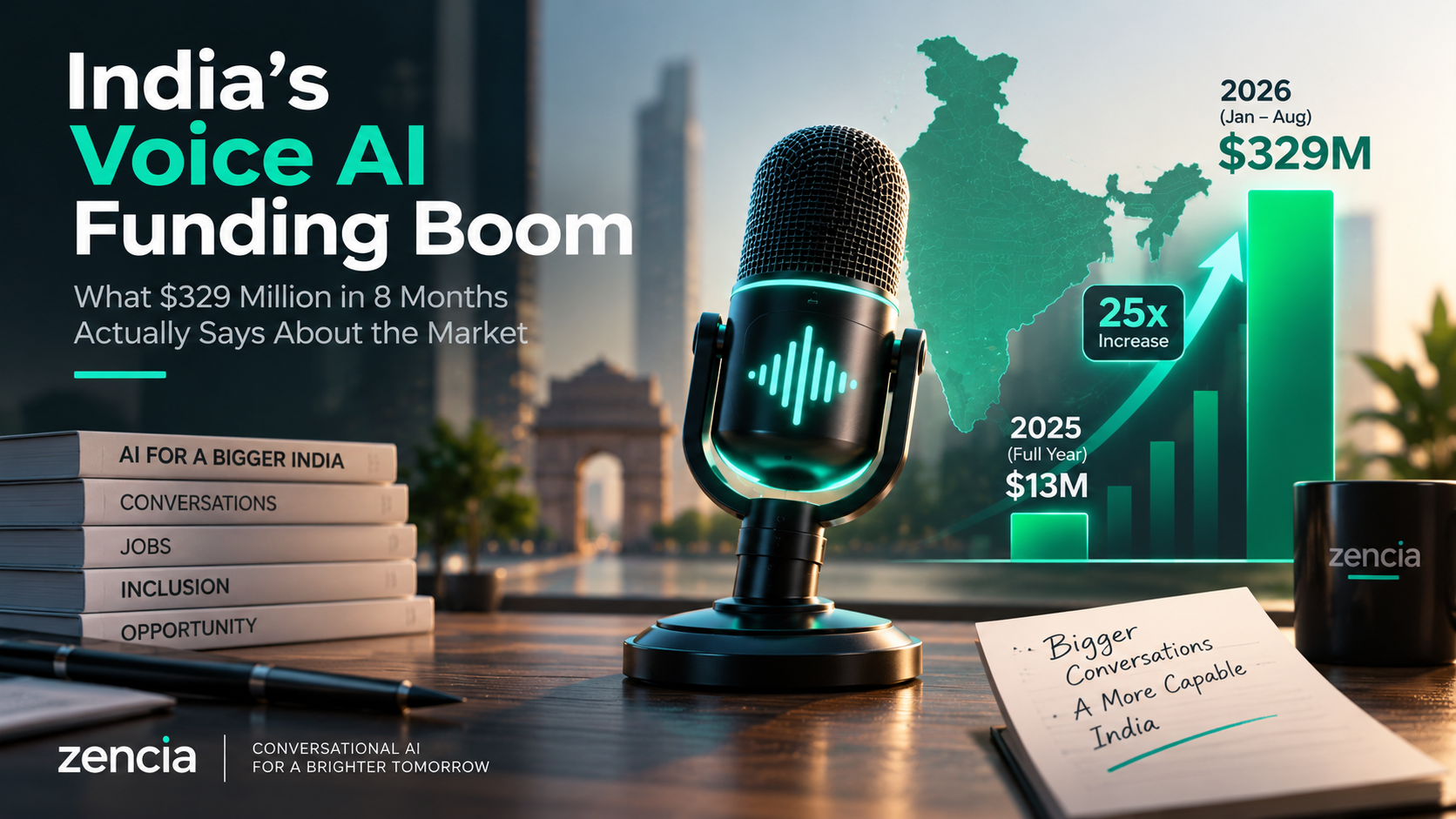
Indian voice AI startups raised roughly $329 million between January and August 2026, spread across just five funding rounds. In the same eight months of 2025, the entire category raised about $12.9 million. That is not steady growth. It is a jump of more than 25 times in a single year.
Cumulative funding across the sector now sits at roughly $449 million, spread across 31 voice AI companies, of which about 20 have raised institutional capital. Eight of those companies were founded in 2023, still the single biggest founding year for the category.
One Company, Most Of The Money
Look closer at that $449 million and the picture changes. Sarvam alone accounts for roughly $350 million of it, close to 78% of everything raised by the entire Indian voice AI sector to date. Strip Sarvam out, and the other 30 companies combined have raised somewhere around $100 million.
That is a very different story than "voice AI in India is booming." It is closer to: one company raised a category-defining round, and a long tail of everyone else is working with a fraction of that capital.
What This Money Is Actually Buying
Most of that funding is aimed at a specific bet: automating enterprise calling, customer support, and collections. It is worth sizing that market honestly.
According to IMARC Group's 2026 market report, India's contact-centre software market grew from about $1.7 billion in 2025 to $2.2 billion in 2026, and is projected to reach $9.6 billion by 2034 at a compound annual growth rate of roughly 20%.
So eight months of voice AI funding in 2026 ($329 million) is close to 15% of the entire current-year size of the market it is mostly aimed at. That is an enormous amount of capital chasing a market that, however fast it is growing, is not yet enormous itself.
The Economics Underneath The Hype
The efficiency case for voice AI in calling and collections is real. Industry estimates put a human agent's effective cost at roughly ₹6 to ₹7 per minute, against roughly ₹2.5 per minute for voice AI at scale, a gap large enough that a business handling a million call minutes a month can realistically save ₹35 to ₹45 lakh. Enterprise pilots in banking, insurance, and healthcare, typically $20,000 to $30,000 to start, are increasingly turning into annual contracts worth $100,000 to $500,000.
Those are good numbers. They are also numbers that only make sense inside the box of "replace or augment a call centre."
The Bet Nobody's Pricing In
Enterprise calling is a very good wedge for voice AI. It is a much smaller bet than the technology can actually support.
If a person can speak a request instead of typing it, that request does not have to stay inside a phone call. It can happen on a website, inside an app, across a support ticket, or through any interface a business already runs, replacing rigid menus and search boxes with something closer to just telling the software what you want.
That version of the category is not a contact-centre replacement market capped at a few billion dollars. It is a bet on voice becoming a basic way people interact with software, the way touch did for mobile. Most of the funding raised so far is not pricing that version in yet, it is pricing in the calling use case.
What This Means If You're Evaluating a Vendor Right Now
A funding headline is not a product signal. A vendor that raised a large round is not automatically more reliable, more accurate, or better priced than one that did not, and a vendor with no funding news at all may simply not need it yet. What is worth asking instead:
- Is this vendor building only a calling product, or a voice layer that can sit on top of more than a phone line?
- Does their roadmap depend on the next funding round, or on the unit economics of what they are shipping today?
- Can they show the product working outside a curated demo, on your own website, app, or support flow?
Where Zencia Fits
We built our product line around the wider version of this bet rather than the narrower one. Echo handles enterprise voice conversations in 20+ Indian languages. Envoy runs sales outreach and lead qualification end-to-end. Scout runs candidate screening at a scale no single recruiter could match. Realto handles property inquiries and site-visit bookings the moment they come in. And our website navigator lets a visitor say what they need, "show me pricing," "book me a demo," and takes them there directly, no call, no menu, no redesign of the site underneath it.
None of that depends on enterprise calling being the whole story. It is built on the assumption that it is not.
The Bottom Line
$329 million in eight months is a real signal that investors believe voice AI in India has a large future. It is a much weaker signal about which companies will actually own that future, since most of that number belongs to one company, and most of the rest is still priced against a contact-center market that is a fraction of the number. The businesses and vendors who do well over the next few years will likely be the ones who treated voice as more than a phone call from day one.
Curious what voice AI built for more than a call center looks like? Meet Zencia's AI employees at zencia.ai.