India's Enterprise AI Shift: From Copilots to Digital Workers
India's enterprises are moving past AI copilots into full digital workers. See what the 2026 data shows and why Zencia built AI employees for exactly this shift.
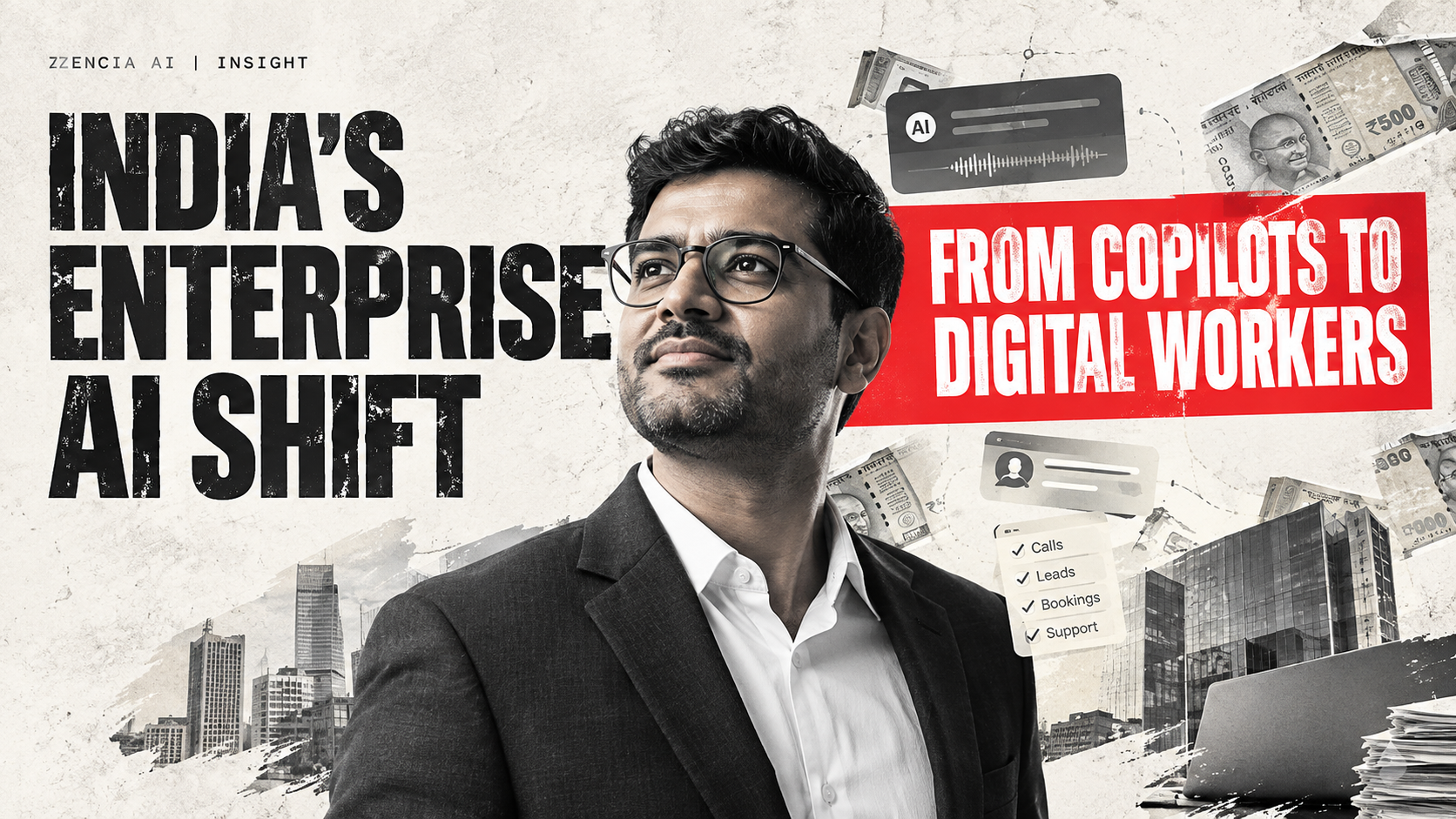
For the last three years, "using AI" at most Indian businesses meant one thing: copilots. A drafting assistant here, a summarization tool there, maybe an AI-powered search bar. Useful, but narrow a human still had to start every task, check the output, and remember what needed to happen next.
That phase is over. In 2026, Indian enterprises have moved into a second wave of AI adoption, and the difference isn't incremental it's structural. Businesses aren't just using AI anymore. They're assigning it work.
The Numbers Behind the Shift
The scale of this shift is no longer a prediction it's already showing up in the data.
According to the NASSCOM AI Adoption Index, cited in a 2026 government report, 87% of Indian enterprises are now actively using AI solutions in some form. That number alone would have seemed aggressive even a year ago. But the more telling statistic sits one layer deeper: over 80% of Indian businesses are actively exploring agentic AI and autonomous agents systems that don't just respond to a prompt, but plan, execute, and carry a task through to completion on their own.
What's driving adoption isn't raw model capability. Industry research points to deployment speed as the real deciding factor how fast a business can actually put an AI system to work as the reason most companies are choosing to buy a ready platform rather than build one in-house.
This matches a broader pattern across Asia-Pacific, where India is emerging as one of the most aggressive enterprise AI adopters globally by some 2026 estimates, ahead of the United States in active usage.
From "AI Response" to "Digital Worker"
The most useful way to understand this shift isn't through adoption percentages it's through a change in what businesses expect AI to be.
In the copilot era, the unit of value was a single AI response: one email drafted, one query answered, one document summarized. In the agentic era, the unit of value is an outcome a lead followed up on, a candidate screened, a customer's call resolved carried out over time, with minimal human hand-holding.
That's not a tool anymore. That's a role.
Analysts are increasingly describing this in exactly those terms: not "AI features embedded in software," but a digital worker occupying an actual position in the organization the way a call handler, a recruiter, or a sales development rep would.
This is the exact reframing Zencia was built around, long before it became an industry talking point.
Why "AI Employee" Isn't Just a Marketing Line
At Zencia, we don't sell AI tools. We deploy AI employees Envoy, Scout, Echo, and Realto each built to own a specific function inside a business, the same way a human hire would:
- Envoy works sales outreach and lead qualification end-to-end following up, booking meetings, and moving deals forward without waiting for a human to trigger the next step.
- Scout runs interviews and candidate screening around the clock, at a scale no single recruiter could match.
- Echo answers every call in under a second, in 90+ languages, and never puts a customer on hold because the office is closed.
- Realto handles property inquiries, site-visit bookings, and buyer qualification for real estate teams the moment an inquiry comes in, not hours later.
None of these are chatbots bolted onto a website. They're built to be deployed the way you'd onboard a new hire given a role, given context, and expected to perform it independently.
What This Means If You Run a Business in India Right Now
The adoption data makes one thing clear: the businesses moving fastest aren't necessarily the ones with the biggest AI budgets or dedicated AI teams. Industry deployment studies across Indian SMBs consistently show the same pattern the strongest results come from identifying one repetitive, high-volume communication workflow (missed calls, slow lead follow-up, manual screening) and handing that specific job to a dedicated AI agent, rather than trying to "add AI" everywhere at once.
That's a lower bar to clear than it sounds. You don't need an engineering team, a data science hire, or a six-month pilot program. You need to know where your business is losing time or leads right now and deploy a digital worker built specifically for that job.
The Bottom Line
India isn't cautiously testing AI anymore. It's restructuring how work gets done enterprise and SMB alike around AI systems that hold real responsibility, not just AI features that assist a human who's already stretched thin.
The question for most businesses in 2026 isn't whether to adopt agentic AI. It's which part of the business should get its first AI employee and how fast you can deploy them.
Ready to find out? Meet your AI workforce at zencia.ai.